What to cut. What to scale. What it should make.
Every change ranked by the revenue it should make. You approve. Then we check whether we were right.
No card required · Live in a day · Works with your existing stack
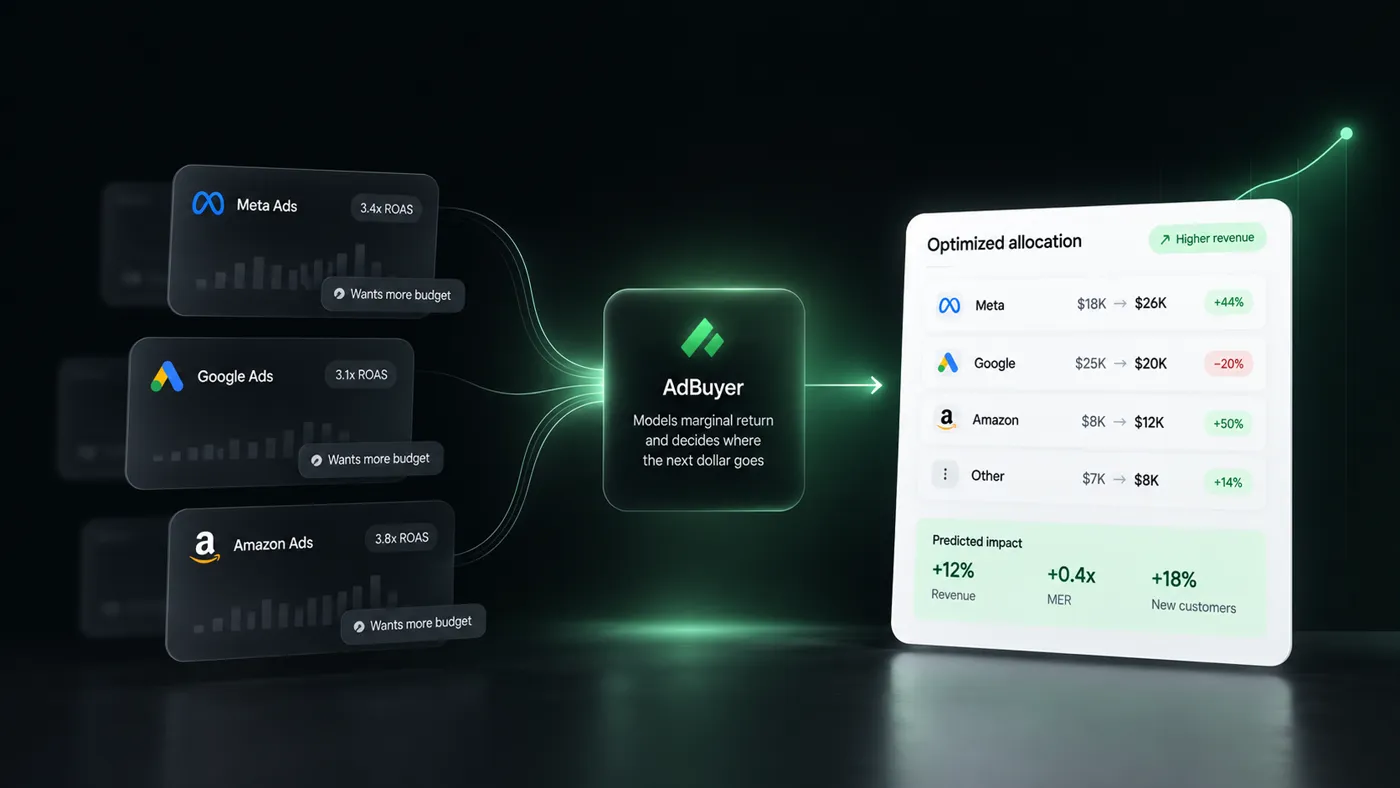
You do not need another dashboard. You need Monday's list.
Advice without a number is a to do. AdBuyer puts the number on first, then holds itself to it.
Five agents, each owning one thing you can change
Budget and pacing
Owns allocation, ramps and rollbacks. Moves spend when the marginal return has shifted, not when a dashboard turns red.
Creative
Owns variants, fatigue and seasonal assets. Scales what is holding CPA and retires what is past frequency threshold.
Audience and targeting
Owns breadth, exclusions and structure. Fixes the exclusions quietly suppressing reach.
Feed and landing
Owns Merchant Center, landing page health and tracking. Fixes the breaks before optimising what already works.
Campaign structure
Owns consolidation, bid strategy and placements. Restructures where the account is fighting the algorithm.
Scored predictions
Each agent carries its own accuracy record, misses included, and that record decides how much weight the next proposal gets.
An AI is not spending your budget
AdBuyer does not have write access to your ad accounts. Today it recommends and you act. Every proposal carries a predicted contribution, the evidence and a confidence level. Execution behind your approval is in development, and this page will say so until it ships.
- Sized against a real gap, this period's shortfall, not generic best practice.
- A predicted contribution on every item, so the list ranks itself.
- Computed on actual orders from your own pixel, not the platform's report card.
- Scored afterward, predicted versus actual, misses included.
- Approved by you. Nothing moves because an agent felt confident.
GMV monitored across the brands we work with.
Connectors feeding reconciled numbers into every proposal.
Recoverable spend found in week one, or you do not pay.
"Whatever you keep an agency for, it should not be pulling the numbers together. One strategist now covers more brands because the analysis is done before they sit down."
Frequently Asked Questions
Consequential product suite
One revenue system. Five jobs.
Move from clean signals to a clear decision, then see whether it worked.
Built to Replace Reactivity
If you're tired of reacting to revenue drops after the fact, Consequential gives you the edge.